Blog Post #2: Visitor-Resident Mapping and Online Presence
Visitor-Resident Map Discussion:
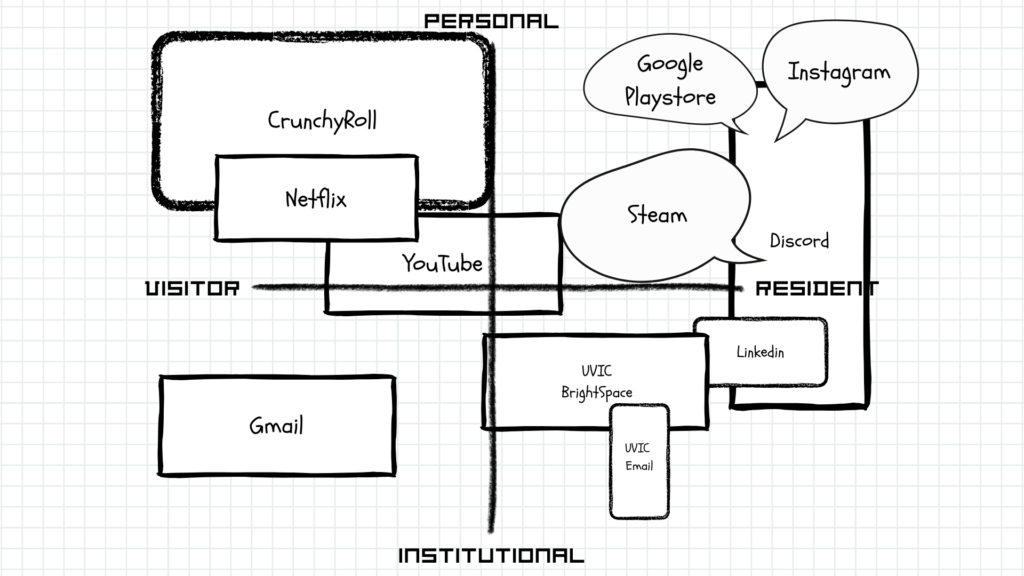
Visitor & Resident Map created by Kevin Jin, created using Canva on 2026-01-30
Overall structure:
- The horizontal axis (Visitor → Resident) represents how permanently and socially I exist on a platform.
- Visitor: I use the platform mainly to consume content or complete tasks, leaving little personal trace.
- Resident: I actively participate, maintain an identity, and interact with others.
- The vertical axis (Personal → Institutional) shows whether the platform is used for personal life or formal/academic/professional purposes.
- The size of each platform reflects its relative importance, frequency of use, and level of engagement in my life. Larger platforms represent spaces where I spend more time or maintain stronger digital identities.
Personal–Visitor quadrant:
- Crunchyroll and Netflix are placed here because they are primarily used for passive content consumption. I don’t interact with others or build an identity on these platforms.
- Crunchyroll is larger than Netflix, indicating it plays a bigger role in my personal leisure time or is used more frequently.
- These platforms sit firmly in the visitor space because I log in, watch, and leave without contributing content.
Boundary between Visitor and Resident:
- YouTube sits near the center because it functions as both a visitor and resident space.
- I often use it passively (watching videos), but it also allows for interaction through comments, subscriptions, and engagement with creators.
- Its position reflects this hybrid use rather than a fixed identity-driven presence.
Personal–Resident quadrant:
- Steam, Discord, and Instagram appear here because they involve ongoing social presence and identity.
- Steam is larger, showing it is a major platform where I maintain a persistent profile, interact with friends, and invest time.
- Discord is strongly resident due to real-time communication and community membership.
Institutional–Resident quadrant:
- UVic Brightspace is large and centrally placed in this quadrant, reflecting its importance for academic life. It requires continuous engagement, submissions, and interaction with institutional content.
- UVic Email supports this space but is smaller, indicating it is more functional and task-oriented rather than socially interactive.
- LinkedIn sits on the institutional–resident side because it represents a professional identity that persists over time, even if interaction is occasional.
Institutional–Visitor quadrant:
- Gmail is placed here because, while institutional communication happens through it, my engagement is mostly transactional. I use it to send and receive information rather than to build a visible or social presence.
Questions to Answer:
- What digital platforms am I currently using to develop my professional network?
- I mainly use LinkedIn to build my professional network by connecting with classmates, professors, and alumni, as well as following organizations related to my field of study.
- What could the student consider in expanding their professional learning network?
- If an employer reviewed my social media presence, they would likely look for professionalism, respectful communication, and evidence of my interest in learning and growth. A consistent and positive digital identity could reflect strong personal values and make me appear more employable. However, unprofessional or careless online content could negatively influence how an employer perceives my suitability for the role.